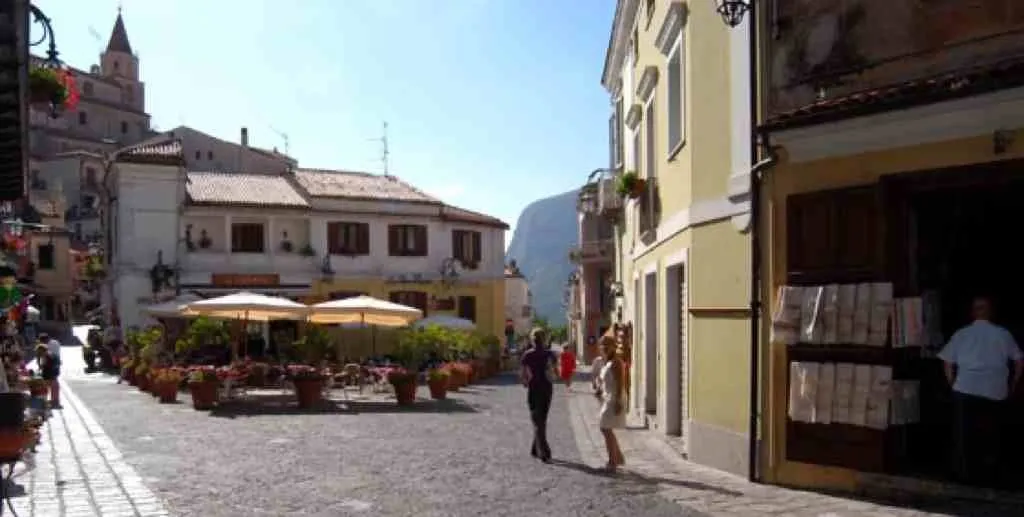
Buraglia Square | Historical Center of Maratea
The "Piazza", the town square, with its churches, streets and narrow lanes
[More from Maratea's Historic Center]
Retrace your steps, then take the narrow alley leading from the bell tower of the Church of Santa Maria Maggiore towards Piazza Buraglia, where you will find the Obelisk of Saint Blaise on the town’s main street.
Erected in 1738, the monument consists of three elements: a stone base bearing the coats of arms of the Bourbon dynasty and Maratea; a marble column, traditionally said to have been recovered from the sea at Cala Jannita; and an 18th-century Neapolitan statue of Saint Blaise.
Behind the obelisk is located the Church of the Annunciation, built in the sixteenth century: two stone lions of the sixteenth century flank the portal surmounted by a painted lunette of the seventeenth century.
A little further on is the Church of the Immaculate Conception, built in the eighteenth century as the seat of a congregation, where during renovation work the original nucleus of the church emerged in the underground levels, definitely worth a visit.
The website www.maratea.info is updated by the volunteers of
- To stay updated on the activities of AltriTurismi ETS ->
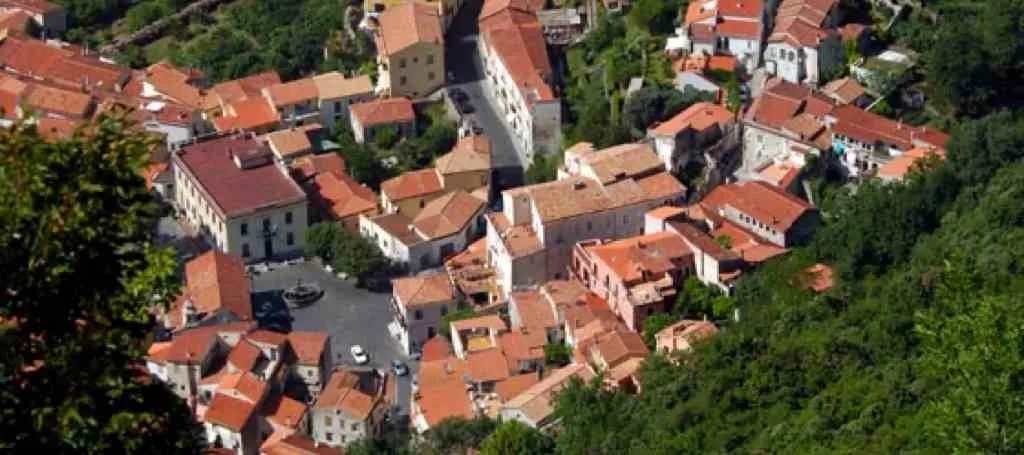
Descending from Piazza dell'Immacolata along Via Casaletto, one reaches the Torre della Calata, and continuing on, facing the portal of the Marini d’Armenia palace (1725).
It is one of the three towers present in the Historic Center and was built in the 16th century, with a square plan, with a tapering base on which rests a second body with a stone cornice; the balcony and the passageway connecting the tower to the adjacent palace are of a later period.
Continue downhill and take Via Molo Piccolo, which leads to the Church of Calvario, dating from the first half of the 14th century. Its façade features a niche containing a fresco dated 1548.
in the vicinity of the Borgo
At the end of Europa Square rises the convent of the Observant Friars, with the attached Church of the Rosary.
The Convent, probably active as early as 1574, as evidenced by a bull of Pope Gregory XIII.
Occupied by Franciscan friars until 1866, it was later transformed into a girls' school, known as the "De Pino Institute".
The convent has a two-story cloister with a double row of semicircular arches supported by Ionic columns.
Annessa is the church of the Rosary with portico and a large single auditorium.
The interior decoration dates back to the early years of the seventeenth century.
Behind the convent is the road that leads to the Municipal Villa, from which one then heads towards Piazza Buraglia, and on the left one encounters a large square on which the Convent of the Capuchins faces, built in 1615 and in use until 1866: today it is the headquarters of the operational center of the Ministry of Cultural Heritage, housing finds recovered in the territory, including amphorae and anchors recovered in Santo Janni.
Adjacent to the convent are the Capuchin chapels, a complex of three small oratories with late-sixteenth-century frescoes.
return to : The Medieval Village
Italy's last travel frontier
A NEW WAY TO EXPLORE THE CITY
AN ENTRING TREASURE HUNT
that unites the entire family in fun
MARATELL. THE LEGACY OF THE SARACEN
A StreetAdventures™ necklace adventure