
Flora & Fauna in Basilicata
Basilicata. What a beautiful Discovery !
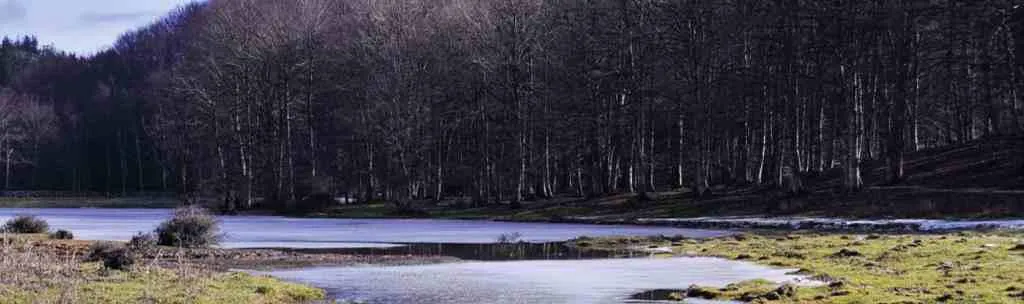
The Lucan natural environments are rich in animal and plant; the same nature of the territory, more than 80% in the high ground and the low density of human settlements, favoring the abundance and diversity of flora and fauna.
Fauna of Basilicata
Among the animal species, in fact, the otter (Lutra lutra) is the most important rarity (see Parco Nazionale Appennino Lucano Val d'Agri e Lagonegrese), present in Italy precisely in the territory corresponding to so-called Great Lucania, that is, the area encompassing Cilento, the mountains of Pollino, and northern Puglia.
In the Lucanian forests, the Fox (Vulpes vulpes) is the dominant species along with Pine Martens (Martes foina), Martens (Martes martes), Weasels (Mustela nivalis), and, of course, the Wild Boar (Sus scrofa).
But the greatest predator in the region is the wolf (Canis lupus italicus), with a concentrated presence in the Pollino massif.
The Lucanian forests are a true paradise for bird watchers, especially for the rich representation of raptors.
The Golden Eagle (Aquila chrysaetos) is present with only two individuals, while very frequent are the Red Kite (Milvus milvus), Common Kestrel (Falco tinnunculus), and Buzzard (Buteo buteo), as well as the Peregrine Falcon (Falco peregrinus), Lesser Kestrel (Falco naumanni), and the increasingly rare Bearded Vulture (Neophron percnopterus).
Flora of Basilicata
The flora of Basilicata includes approximately 2,350 species, which is significant given the region's small surface area. However, the most important aspect is the high number of endemic species: a remarkable 168 species, or 6.5% of the regional flora, which is one of the highest values in Italy.
Along the Tyrrhenian coast (MARATEA), the Mediterranean maquis consists of cork oak, mastic tree, shrub eryngo, tree spurge, juniper, pistachio, olive, fig, and carob. On the Ionian coast, sea daffodil, sea lavender, and beach ammophila, as well as juniper, mastic tree, and myrtle.
Most of the inner area is mountainous and features oak forests such as cork oak, holm oak, and sessile oak, along with maples, ashes, and elms.
Not uncommon are chestnut woods while beech is present on the Pollino massif even above 1,300 meters, together with the Silver Fir.
The Bosnian pine (Pinus leucodermis) is the Pollino’s most distinctive plant species and the emblem of the National Park.
A very long-lived pine
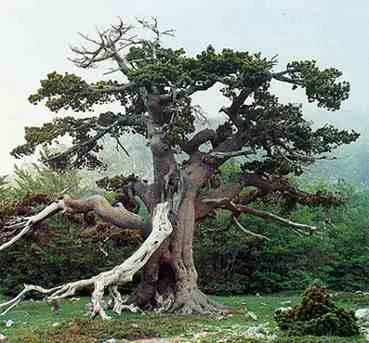
A white-skinned conifer from the Balkans, which has withstood the onslaught of the beech for millennia, the Bosnian pine stands between 900 and 2,100 meters high and is among the longest-lived plants of all, with specimens reaching up to 950 years of age.
The website www.maratea.info is updated by the volunteers of ALTRITURISMI.it
MAKE A DONATION
- To stay updated on the activities of AltriTurismi ETS -> Subscribe to the newsletter