
The ancient Lucania
Great Lucania
Ancient Lucania extended from the Sele River in Campania to the Laos River in Calabria, covering the entire territory of present-day Cilento and the northern part of Enotria.
This representation seems to be the maximum extent of territory governed by the people of the Lucani, of Oscan origin, who arrived along the banks of the Basento River in the 5th century BC.
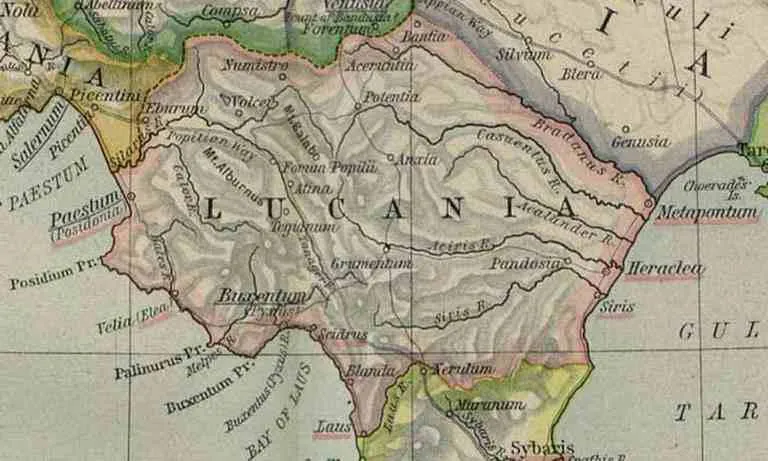
Mario, Silla, Pyrrhus, Hannibal, etc.
The Lucani were a people with a turbulent history, marked by shifting alliances, victories and reversals, conquests and losses of cities and territories. Their fate was sealed when they were overwhelmed by the Romans and definitively defeated in 82 BC, at the Battle of Porta Collina.
That confrontation was the denouement of the civil war between Marius — with whom a part of the Lucani had aligned themselves — and Sulla, who emerged victorious. The consequence was harsh: Lucani wealth and possessions were dispersed, absorbed, and gradually Romanized, eroding the very roots of their civilization.
Over the centuries, the Lucani fought or allied themselves, depending on the circumstances, with Greeks and Samnites, with the king of Epirus and with the Bruzi, with the Tarantines, and finally with the Romans.
Among the most celebrated episodes of their epic, the victory of Pyrrhus stands out, achieved thanks to the use of elephants: the Romans, who had never seen them before, called them "Lucanian oxen." For other reasons, however, the deeds of Hannibal must also be remembered, who for years crossed Lucanian territories plundering them, despite having them as formal allies.
Great Lucania
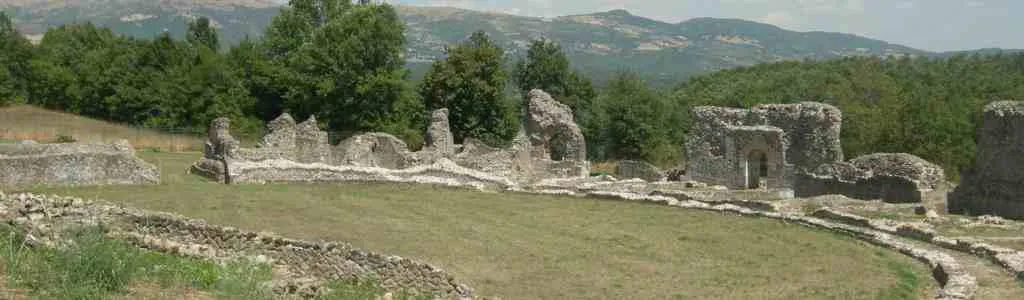
The Great Lucania is a cultural and political movement aimed at reconstructing administratively that geographical, dialectal, and physical unity that is Lucania.
In recent decades, a movement has been created, especially among the populations of the Cilentan municipalities in Campania, with the aim of becoming part of Basilicata again.
This is not only considering the geographical boundaries of ancient Lucania, which, depending on the period being discussed, extended from the Sele river in the province of Salerno to the Lao plain in Scalea, but above all for the elements of historical and cultural continuity that unite these territories.
Without forgetting that there are also toponyms (such as Vallo della Lucania and Atena Lucana) that recall the affiliation of those areas to Greater Lucania.
The movement aims to involve citizens and institutions through cultural, political, and scientific activities in order to hold referendums that allow citizens to express their will to reach a possible administrative aggregation of the communities of Cilento and Vallo di Diano with Basilicata.
The website www.maratea.info is updated by the volunteers of ALTRITURISMI.it
MAKE A DONATION
- To stay updated on the activities of AltriTurismi ETS -> Subscribe to the newsletter