medieval Maratea
THE SARACENI PIRATES
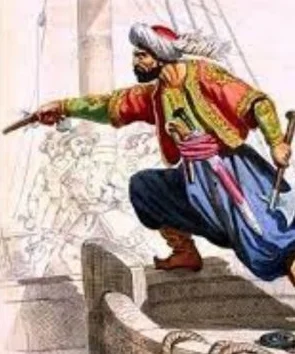
After following the fate of the Western Roman Empire and being annexed to the Byzantine Empire, the populations of the coastal cities of southern Italy were forced during the Middle Ages to abandon their ancient homes, threatened by barbarian raids and Saracen pirates, in favor of the mountain peaks, places less hospitable but much more defendable.
In the High Middle Ages, the population present in the Maratea territory took refuge on the summit of Mount S. Biagio, where the town was founded and took the name of "Marathia," a Greco-Byzantine word indicating a place abundantly affected by the presence of wild fennel.
The town, naturally protected by the rocky spurs of the mountain, was further fortified with the erection of walls and towers, of which only a few ruins are now visible.
There are two gates to access the town: Porta S. Maria, located on the southern side, and Porta dei Carpini, on the opposite side.
CHRISTIANITY
MARATEA BASILIANA CAVE
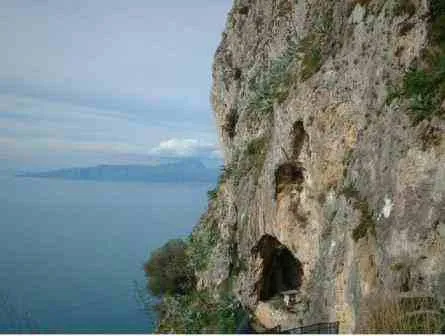
The population soon embraced Christianity, whose rituals were initially practiced in the Angel Cave, a cavity on the mountain near the homes of the ancient city.
Churches were then built for St. Basil (near the cave), St. Mary (near the gate with the same name), and Our Lady of Graces, adapted from the ancient temple of Minerva for Christian worship.
This church later became the sanctuary of the patron saint when, according to an ancient legend passed down through generations, the relics of St. Blaise of Sebaste arrived in Maratea transported by a crew of Christian Armenians.
During the Paleo-Christian period, Maratea was involved in the phenomenon of Italo-Greek monasticism, often erroneously called "Basilian," which encouraged Christians to dedicate themselves, for brief or extended periods, to a hermitic life in caves or monasteries: visits to the Hermit Cave (near Acquafredda), the Zu Janco Cave (near Marina), and the ancient hermitages scattered throughout the territory, of which some examples still survive, date back to this period.
THE CASTLES
In 1079, a document by the bishop of Salerno, Alfano, lists the townships of Marathia and Castrocuccu within the diocese of Policastro; the latter should be identified not with the current fraction, but with the village that developed around the majestic castle of the same name.
If the ancient Castrocucco was subjected to a feudal lord on multiple occasions, this was not the case for Maratea, which as early as 1278 appeared in the list of castles and fortresses under the domain of Basilicata, and over the centuries was endowed with numerous privileges by the Neapolitan sovereigns.
In 1284, Maratea was involved in the War of the Vespers, fought by the French and Spaniards for the conquest of the Kingdom of Naples.
After the fall of Policastro and Scalea into enemy hands, Maratea suffered violent attacks for many months but never surrendered to the invaders.
In 1440, Maratea was attacked by the count of the nearby city of Lauria, but the enemies were soundly defeated, to the point of being forced to compensate the Marateans for the damage caused.
In 1495, it suffered a new siege, this time by the troops of King Charles VIII of Angevin, but a miracle of St. Blaise, which is said to have awakened the sleeping sentinels with slaps, saved the population on Mount St. Blaise from raids and plunder
Treasure Hunt
A NEW WAY TO EXPLORE THE CITY
AN EXCITING TREASURE HUNT
that unites the entire family in fun
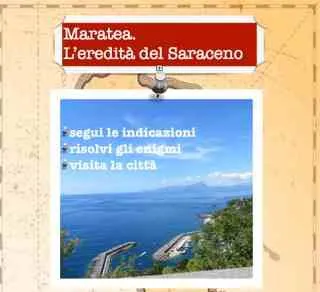
MARATEA: THE SARACEN’S LEGACY
A StreetAdventures™ necklace adventure