
Angel 's Grotto | Church | CASTLE
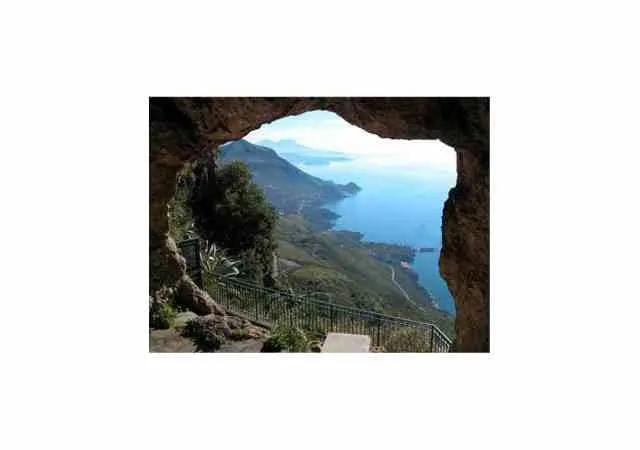
The Church of Angel's Grotto is a natural cavity located on Mount S. Biagio in Maratea, directly below the right hand of the Redeemer's statue.
Works of art in the Church
The cave provides evidence of ancient visits, featuring a fresco on the bare rock, dating back to the 10th-11th centuries, depicting the Crucifixion, surrounded by figures of the Father above, and the Sun and Moon on the upper sides, with St. John and St. Michael the Archangel.
And it is this figure to whom the grotto owes its dedication.
On the floor of the cavity is a memorial plaque in memory of Count Stefano Rivetti
Visit the Angel Cave
The path to reach the Cave, from the ruins of the Maratea Castle, has a high degree of difficulty.
It is only recommended to visit it with an expert guide.
Mount Saint Blaise Maratea
Angel's Grotto
Historical notes and visit tips
Naming the Angel's Grotto of Maratea is an image that has endured for centuries on the rock: that of Saint Michael the Archangel, part of a preserved pictorial composition inside. It is this testimony that tells the sacred function of a secluded place, carved out of a natural cavity on Mount San Biagio.
The fresco, generally dated between the 10th and 11th centuries and attributable to the Byzantine tradition, has as its main subject the Crucifixion. Time has erased some parts: very faint traces remain of the Virgin Mary, while next to Christ a figure identified as Saint John is recognizable. Completing the scene are Saint Michael, the personifications of the Sun and Moon, and, above, a figure interpreted as the Eternal Father.
Who prayed before these images? The answer remains open. Popular tradition attributes a leading role to the grotto in the origins of local Christianity, identifying it as the oldest Christian place of worship in Maratea. However, this is a tradition, not a historically verified fact. The hypothesis of its use by Greek rite monks places it instead in the context of the widespread eremitic life in southern Italy.
Some elements of the environment help to imagine how it might have been inhabited. Raised surfaces would have allowed separating the prayer space from the rest area; in particular, the smaller and more sheltered shelf has been interpreted as a possible support for a bed. The visible soot marks on the walls are linked to the presence of fires. Instead, the tablet dedicated to Count Stefano Rivetti, placed on the floor, belongs to a much more recent memory.
The cave lies on the southern slope of the mountain, beneath the Christ the Redeemer statue, directly below its right hand. Its entrance faces the coast, but its location makes access difficult.
The possibility of visiting it should be verified in advance: in addition to the difficulties of the route, we suggest finding out about access conditions and the availability of qualified accompaniment because access is through a steep and difficult path and there are limitations related to private property.